
Manchester Musings - Community Research Network Away Days
- May 6
- 3 min read

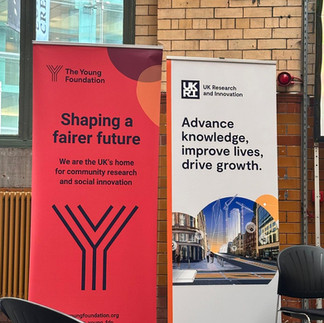
We recently travelled to Manchester for the annual Community Research Network Away Days - a gathering hosted by The Young Foundation in collaboration with UK Research and Innovation. Bringing together the nine networks from across the UK, the event offered space to reflect, connect, and collectively reimagine a deceptively simple concept: what is research for, and who is it really serving.
Shifting the centre of gravity
It’s easy to underestimate how unusual this is. Research, in its conventional form, tends to orbit institutions: universities, funders, policy bodies, each with their own incentives and languages. What this programme has been doing, quite deliberately, is shift the centre of gravity. Communities are not consultees or beneficiaries, but in the lead.
It was a long journey for us, but that felt appropriate. These are not quick conversations. They require time, and a willingness to sit with difference - between places, between priorities, between ways of knowing. What emerged over the two days was not consensus so much as alignment: a shared sense that the existing model of research is insufficient for the problems it is meant to address.
Knowledge, and who gets to count
Despite representing a wide range of contexts, from rural communities to urban centres, clear patterns emerged. Communities whose voices are rarely heard in formal decision-making are nevertheless rich in knowledge. The question is not whether that knowledge exists, but why it has been so consistently marginalised. Community-led research begins to answer that by reorganising the process: starting from lived experience rather than abstract problem definitions, and building outwards.
From local insight to systems change
There is, of course, a politics to this. Moving from local insight to national influence is not simply a matter of scaling up; it involves challenging assumptions about expertise and authority. A panel discussion brought this into focus, with contributions from across academia, policy and practice. What was striking was not just the growing recognition of community perspectives, but the implicit admission that existing systems have blind spots.

This programme represents a substantial investment and a significant step forward in championing a ‘bottom-up’ approach to research. If communities define the questions, then research becomes less about extraction, more about collaboration; less about validation, more about action. That has implications how we think about evidence itself.
Tom Saunders, Head of Public Engagement at UK Research and Innovation (UKRI) who attended the event said “the Community Research Networks programme is the largest investment UKRI has made in community-led research. By placing community organisations in the lead, rather than academic institutions, it marks a fundamental shift in how research is conceived and delivered. Supported by The Young Foundation, the initiative is building capacity across the UK, enabling communities to take ownership of research and use it as a tool for change”.
Learning sideways
The Away Days provided an opportunity for horizontal learning and collaboration: the exchange of experiences across contexts. Through a range of activities, there were discussions about how to sustain the concept, about impact, and about the practicalities of doing this work in a system not designed for it. There was also a recognition that this is no longer a fringe activity, but part of a broader reconfiguration of research.
A museum, a ceilidh, and the social life of research

The setting was meaningful - The People’s History Museum, with its focus on democratic participation and collective action, provided a reminder that many of the rights and structures we now take for granted were once contested and uncertain. Research may not feel like a site of struggle in quite the same way, but the parallels are there: questions of voice, power, and legitimacy.

And in true community spirit, the event also included lighter moments. Between sessions and conversations, an impromptu ceilidh brought people together with music, laughter, and dancing. It was a joyful reminder that connection and shared experience are social as well as formal.
What comes next
We left Manchester with more questions, but there was also a clearer sense of direction. If research is to be more inclusive, more responsive, and more useful, then it will need to continue shifting - away from established hierarchies and towards the messy, generative space of community-led work. These events show that there is growing recognition for our central objective: that research can, and should, be more inclusive, collaborative, and grounded in the realities of people’s lives.
That shift is already underway. The task now is to sustain it, and to take seriously the idea that expertise does not sit in one place.








Comments